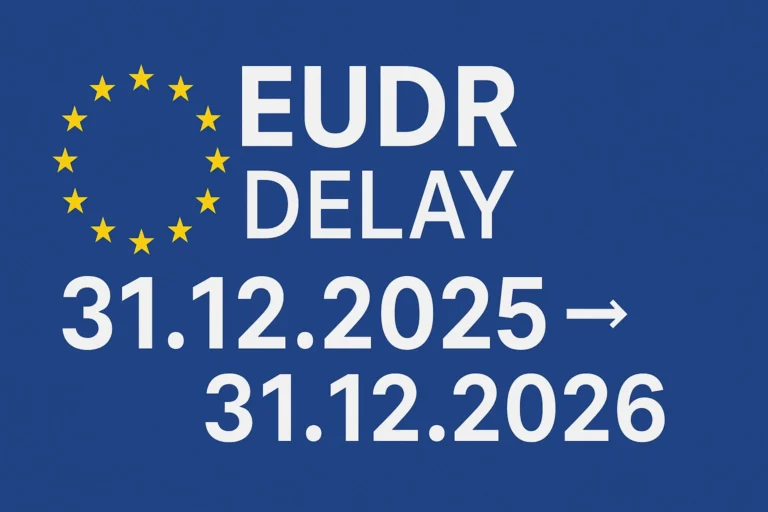

On December 4, 2025, the European Commission announced a provisional political agreement between the European Parliament and the Council on targeted amendments to the EU Deforestation Regulation (EUDR). This breakthrough provides much-needed clarity and predictability for businesses preparing to comply with the landmark environmental legislation.
Key Changes to Implementation Timeline
The most significant change is an additional year for economic operators to prepare before the EUDR enters into application:
| Operator Type | New Entry into Application Date | Previous Date |
|---|---|---|
| Large and medium operators | December 30, 2026 | December 30, 2025 |
| Micro and small operators | June 30, 2027 | June 30, 2026 |
| Micro and small operators already covered by EUTR | December 30, 2026 | December 30, 2025 |
Major Simplifications for Businesses
1. Streamlined Obligations for Downstream Operators
Downstream operators and traders will benefit from significantly reduced administrative burden:
- No longer required to submit due diligence statements
- No need to pass reference numbers further along the supply chain
- Only the first actor downstream will need to collect a due diligence reference number
2. Simplified Declaration for Small Operators
Micro and small primary operators from low-risk countries will now submit a simplified one-off declaration instead of full due diligence statements. Where information is already available in existing EU or Member State databases, these operators may be completely exempted from submitting the declaration.
3. Product Scope Adjustment
Books, newspapers, and printed materials have been removed from the EUDR product scope, reducing compliance requirements for the publishing industry.
Why These Changes Matter
“The agreement reached by the European Parliament and Council provides the necessary certainty and predictability to businesses, so that they can prepare for the application of the EUDR. I am glad that we managed to swiftly address the capacity issues of the IT system and we will now work on the implementation of the law in the most efficient way possible, so that we can reduce global deforestation.”
— Jessika Roswall, Commissioner for Environment, Water Resilience and a Competitive Circular Economy
The amendments address critical capacity issues with the EUDR IT system by reducing the data load, ensuring it can handle the expected due diligence statements and simplified declarations from all operators. According to Commission estimates, these simplification efforts will lead to a 30% reduction in administrative costs and burden for companies.
Next Steps: Parliament Vote on December 16
Important date: The European Parliament is scheduled to vote on these targeted amendments on December 16, 2025. Following parliamentary approval, the Council will need to formally adopt the amendments before they can enter into effect.
Background: Why the EUDR Matters
The EU Deforestation Regulation addresses one of the most pressing environmental challenges of our time. Key facts:
- Climate Impact: Global deforestation and forest degradation accounts for 10% of worldwide greenhouse gas emissions
- Scale of Deforestation: Between 1990 and 2020, 420 million hectares of forest—an area larger than the European Union—were lost to deforestation
- Regulation Goal: Ensure key goods placed on the EU market no longer contribute to deforestation and forest degradation anywhere in the world
Commission Preparation Efforts
Since the EUDR entered into force in June 2023, the Commission has worked extensively with stakeholders on implementation:
- December 2025: Agreed on further amendments for additional year and simplifications
- April 2025: Published additional Guidance and Frequently Asked Questions (FAQs)
- May 2025: Released Benchmarking Implementing Regulation
- December 2024: Granted initial 12-month phasing-in period extension
Resources and Further Information
For businesses and stakeholders seeking more information:
- EU Deforestation Regulation Implementation
- Strategic Framework for International Cooperation Engagement
- Press Release: IP/25/2939
What Businesses Should Do Now
With the December 16 vote approaching and implementation timelines now clearer, businesses must take decisive action. The regulatory landscape has fundamentally changed, creating both opportunities and new compliance challenges.
For Operators (Importers and Primary Producers)
Critical consideration: With many downstream operators now excluded from direct obligations, the regulatory spotlight will intensify on you as an operator. Expect higher scrutiny and increased control frequency from authorities, as enforcement resources will concentrate on a smaller pool of directly obligated companies.
Operators should immediately:
- Strengthen due diligence systems: Review and enhance your due diligence procedures to withstand heightened regulatory scrutiny
- Document everything: Implement robust documentation systems for all supply chain interactions, risk assessments, and mitigation measures
- Prepare for audits: Develop audit-ready documentation packages that demonstrate compliance with EUDR requirements
- Verify your classification: Confirm whether your company qualifies as large, medium, micro, or small to determine your compliance deadline
- Check EUTR coverage: If you’re already covered by the EU Timber Regulation, note your earlier compliance date of December 30, 2026
For Downstream Traders and Operators
While your direct reporting obligations have been streamlined, you remain legally liable alongside your suppliers if non-compliant products enter your supply chain. The simplification does not eliminate your compliance risk—it shifts your focus.
Priority actions for downstream companies:
- Map your supply chain immediately: Deploy surveys and documentation tools to identify:
- Who in your supply chain are operators (with full EUDR obligations)
- Who are downstream operators or traders (with streamlined obligations)
- Your specific responsibilities based on your position in the chain
- Implement supplier due diligence tools: Even without direct reporting obligations, you must evaluate supplier compliance risk:
- Assess whether your suppliers have adequate EUDR compliance systems
- Verify suppliers can provide due diligence reference numbers
- Identify suppliers who present elevated compliance risks
- Establish ongoing monitoring mechanisms
- Document meaningful supplier engagement: Create audit trails demonstrating:
- Regular communication with suppliers about EUDR requirements
- Requests for and receipt of compliance documentation
- Actions taken when compliance gaps are identified
- Decisions to continue or discontinue supplier relationships based on compliance factors
- Develop contractual safeguards: Update supplier contracts to:
- Require EUDR compliance warranties
- Establish information-sharing obligations
- Define remediation procedures for non-compliance
- Clarify liability allocation
- Prepare for the first-actor-downstream role: If you’re the first downstream actor, ensure systems are ready to collect and manage due diligence reference numbers
For All Companies in the Supply Chain
- Monitor the December 16 vote: Stay informed about the Parliamentary decision and any subsequent Council adoption
- Review official guidance: Study the Commission’s April 2025 FAQs and May 2025 Benchmarking Implementing Regulation in detail
- Assess IT system readiness: Whether you’re submitting full due diligence statements or simplified declarations, ensure your systems are prepared
- Consider the 30% cost reduction: Leverage the Commission’s simplification measures to optimize your compliance approach
- Engage with industry associations: Participate in sector-specific guidance development and share best practices
- Budget for compliance: Allocate resources for systems, training, and potential third-party verification services
- Train your team: Ensure procurement, legal, and operations teams understand the new requirements and timelines
The Bottom Line: Compliance is Everyone’s Responsibility
The streamlined obligations do not create a compliance-free zone for downstream operators. Legal liability remains throughout the supply chain. Companies that treat the simplification as an opportunity to disengage from EUDR compliance are exposing themselves to significant legal and reputational risk.
The additional year is not a grace period—it’s a preparation window. Use it wisely to build robust, documented, defensible compliance systems. With fewer companies under direct obligation, enforcement intensity will increase, and the cost of non-compliance could be substantial.
Act now. The clock is ticking toward December 30, 2026.